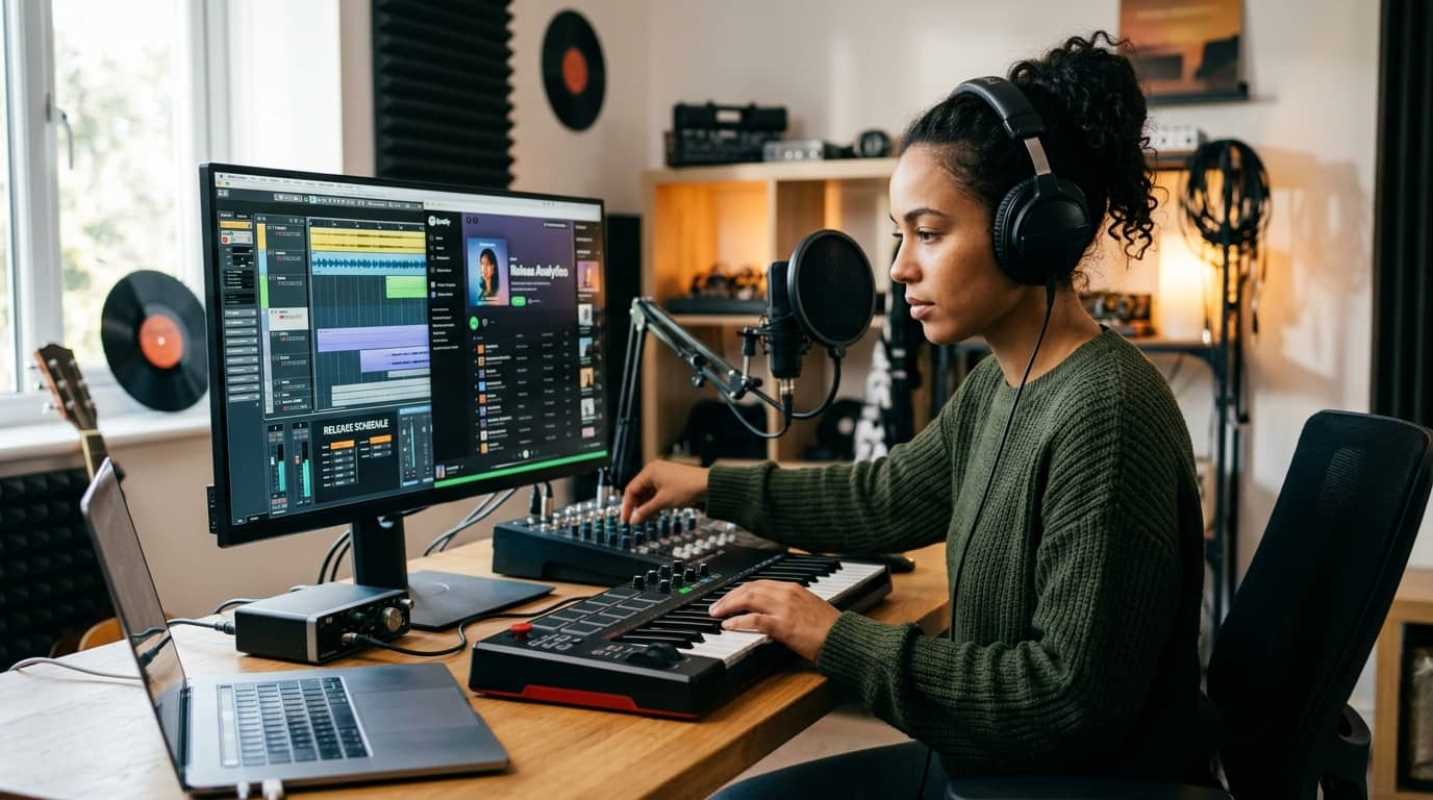
Remember the days when releasing an album was a massive, singular event? You would circle the date on your calendar, line up outside a record store, and buy a physical CD. You would go home, rip off the plastic wrap, and listen to all twelve tracks in order. Today, that entire process feels like ancient history. The way we consume music has completely shifted, and as a result, the way artists share their work with the world is unrecognizable.
The Death of the Traditional Album Cycle
For decades, the music industry ran on a strict, predictable clock. An artist would disappear for two years, write and record a dozen songs, release a lead single to the radio, and then drop the physical album with a massive promotional push.
That rigid two-year cycle is dead. In the streaming era, if you disappear for two years without posting or releasing music, the algorithms will forget you exist. Musicians now have to adopt an always-on content approach to stay relevant in a crowded digital space.
How do you keep people paying attention without burning out? Many artists now use what the industry calls the waterfall release approach.¹
Instead of dropping a whole album at once, an artist releases one song. A few weeks later, they released a second song, but they bundled it with the first one as a single package. They keep doing this, adding track after track, until the full EP or album is complete.²
This approach offers several distinct benefits:
• Algorithmic favorability: Every new track addition counts as a fresh release, triggering algorithmic playlists like Release Radar.³
• Listener retention: When a listener finishes the latest single, the platform automatically plays the previous connected tracks.¹
• Extended campaign life: Instead of a single release day, an artist can stretch their promotional window over several months.
But this approach isn't a magic fix. Luminate's data shows that out of 5.1 trillion songs streamed globally, a staggering 120.5 million tracks received fewer than ten streams.⁴ If your music doesn't connect with people, uploading it multiple times in a waterfall format just means you're shouting into an empty room.
The Rise of the Singles-First Economy
Have you noticed how albums seem shorter these days, or how they feel more like collections of loose tracks than cohesive stories? That's because digital music distribution is built for the singles-first economy.⁵
Streaming platforms don't care about the artistic flow of a 45-minute concept album. They care about individual tracks that can fit into curated mood playlists like "Chill Lofi Beats" or "Beast Mode."
To survive, many artists are skipping the traditional album format entirely or saving it for much later in their careers. Instead, they focus on a strict four-to-eight-week release cadence. This keeps them constantly in the pitching pipeline for editorial playlists.
Then there's the TikTok factor. Luminate's research shows that 84% of the songs entering the Billboard Global 200 went viral on TikTok first.
Because of this, artists aren't just releasing a single song anymore. They're releasing multiple variations of the exact same track to feed the social media machine.
Take Sabrina Carpenter's success. To secure her top spots on the charts, she released seven different versions of "Please, Please, Please" and five different versions of "Espresso," including sped-up, slowed-down, and acoustic mixes. It's a highly calculated way to get the most from streaming numbers and give content creators different audio options for their videos.
Data-Driven Decision Making in the Music Industry
In the past, record labels relied on gut instinct and radio DJs to figure out which songs would be hits. Today, the music industry is run on cold, hard data.
Artists and labels have access to real-time analytics dashboards that show exactly who is listening, where they live, and when they skip a track. This data-driven approach has changed how projects are put together.
Have you ever noticed how songs seem to get straight to the point now? There's no room for a long, slow intro anymore. If a listener skips your song in the first thirty seconds, the streaming platform's algorithm flags it as a skip, which hurts your overall visibility.
Because of this, songwriters are structuring tracks to hit the hook almost immediately. It's a direct reaction to the data showing that modern attention spans are shorter than ever.
Instead of committing to a full album budget upfront, an artist can upload a few demos or short clips to TikTok and Instagram to test the waters. If a fifteen-second snippet goes viral, the artist knows they have a viable track and can rush to finish and master the song. If it flops, they can quietly abandon it without wasting thousands of dollars.
Social media virality now dictates release timelines. A song that was planned for next year might get rushed to streaming platforms in forty-eight hours because a dance trend took off on TikTok. It's a fast, reactive way of working that leaves very little room for long-term planning.
The Evolution of Album Art and Visual Storytelling
The shift to digital has also changed how we look at music. The classic twelve-by-twelve vinyl sleeve is no longer the primary canvas for visual storytelling.
Now, physical album art has been replaced by dynamic digital canvases and short-form video assets. When you play a song on Spotify, you don't just see a static cover. You see an eight-second looping video, known as a Canvas, that helps set the mood of the track.
This means artists have to think about visual consistency across multiple platforms at once. The visual identity of an album has to be adapted for mobile-first consumption, working just as well on a tiny smartphone screen as it does on a billboard.
We're seeing artists create entire visual packages for every single track, including lyric videos, behind-the-scenes clips, and customized social media filters. It's no longer just about the music. It's about creating a cohesive, multi-sensory digital experience that fits in the palm of your hand.
If you are an independent artist looking to handle this fast-changing environment, having the right tools matters. Here are some of the best services and platforms to help you distribute your music, analyze your data, and reach new fans.
Adapting to the Future: Sustainability and Success
So, where does all of this leave the album as an art form? It's easy to look at the modern streaming environment and feel a bit cynical. The constant pressure to produce content can feel like a creative trap. But some of the biggest artists are proving that you can still balance artistic integrity with the demands of the algorithm.
Look at Billie Eilish's release of her album Hit Me Hard and Soft. She refused to release any pre-album singles because she wanted fans to experience the record as a complete, cohesive journey. It was a massive risk in a singles-driven market, but it paid off with her career-best debut.
On the other end of the spectrum, Taylor Swift used algorithmic dominance to her advantage with The Tortured Poets Department, dropping a surprise double-album expansion to get the most from her streaming units.
We also saw a massive push toward direct-to-fan subscription models. Platforms like Vault and Patreon promised to bypass streaming giants altogether by letting fans pay a monthly fee for exclusive music.
But by late 2025, the subscription bubble showed signs of bursting. Even major independent artists like James Blake, who launched a highly publicized five-dollar-a-month subscription service, quietly pulled the plug. It turns out that forcing artists into a rigid monthly content schedule doesn't match how they actually create music. It adds creative pressure instead of relieving financial stress.
For independent artists without major label budgets, the key to sustainability is shifting the focus from mass casual streams to deep fandom. Streaming pays very little, usually between $0.003 and $0.005 per stream. Chasing billions of streams is a losing game for most.
Instead, building a dedicated community of superfans who will buy physical vinyl, purchase merchandise, and support you directly is the most reliable path to a long-term career. As we look at the music world in 2026, the album isn't dead, but the old rules of how to share it are gone forever.
Sources:
1. What is a Waterfall Release Approach?
https://revelator.com/blog/what-is-a-waterfall-release-approach
2. The Waterfall Music Release Approach
https://thornelabs.io/cheatsheets/the-waterfall-music-release-approach
3. Waterfall Release Approach
https://loopsolitaire.co.uk/blog/waterfall-release-approach/
4. Luminate's Year-End Report of Music in 2025
https://www.ajournalofmusicalthings.com/luminates-year-end-report-of-music-in-2025-is-here/
5. Album vs Singles Approach 2025
https://artistrack.com/album-vs-singles-approach-2025/





.png)