A kitchen knife is close to immortal, and almost nobody treats it that way. The blade of a decent knife can survive twenty years of daily cooking with its steel barely diminished — yet drawers everywhere hold knives that are functionally dead, not because they wore out but because nobody ever maintained the one part that matters: the edge. This review looks at knives across a two-decade horizon: how steel, handles, and edges actually age, what the sharpening habit really costs in time and money, which failures end a knife, and why the cheapest knife you will ever own is a good one you learned to sharpen.
What Aging Actually Means for a Blade
Knife steel does not fatigue in normal kitchen use the way moving parts do; a blade ages almost entirely at its edge. Cutting rolls and blunts the microscopic apex, boards abrade it, and careless contact with plates, sinks, and other knives chips it. Sharpening restores the edge by removing a whisper of steel, which means a knife's true lifespan is measured in millimeters of blade width — and at home-cook sharpening rates, a blade holds decades of millimeters. Professional knives ground down to slivers show what heavy daily sharpening eventually does; home knives essentially never get there.
The steel's character shapes the aging experience more than its lifespan. Softer stainless blades blunt faster but sharpen forgivingly and shrug off abuse; harder steels hold their edge longer but chip more readily and demand better technique on the stones. Carbon steel adds a maintenance relationship — it discolors into a working patina and will rust if left wet — in exchange for easy, keen sharpening. None of these choices is wrong; each just distributes the maintenance differently across the years.
The Failures That Actually Kill Knives
Since edges are renewable, the mortal failures live elsewhere. Handles fail first: wooden scales dry, crack, and loosen around their rivets — dishwashers do this in months rather than years — and cheap molded handles separate from the tang. A loose handle on a riveted knife is a craftsman's repair at best; on a budget knife it is usually the end. Tips break when knives are dropped, pried with, or used to open packaging; a broken tip can be reground into a working profile, at the cost of some blade. Bolsters on cheaper forged knives wear into awkward bumps that block full-length sharpening. And deep chips from frozen food, bones, or glass boards can require removing so much steel that the knife's geometry never fully recovers.
Note what is missing from the list: dullness. A dull knife is not a worn-out knife. It is a maintenance task nobody performed.
Serrated knives are the exception that proves the rule. Their scalloped edges cut acceptably long after a plain edge would demand attention, but they are genuinely difficult to sharpen at home, and most owners treat them as slow consumables. A serrated bread knife earning daily use eventually gets replaced rather than restored — which is a reasonable bargain, given how many years the first edge lasts, and one worth remembering when deciding where to spend within a knife budget.
The Sharpening Habit: The Whole Ballgame
Every long-term knife story is really a sharpening story, and there are only three sustainable versions. The first is learning to use a whetstone: a modest one-time cost, a skill acquired over a few sessions, and thereafter a lifetime of edges for free. The second is a quality guided or manual sharpener at home: less romantic, slightly rougher on steel, entirely adequate. The third is professional sharpening a couple of times a year: a small recurring cost and zero effort, ideal for owners who know themselves.
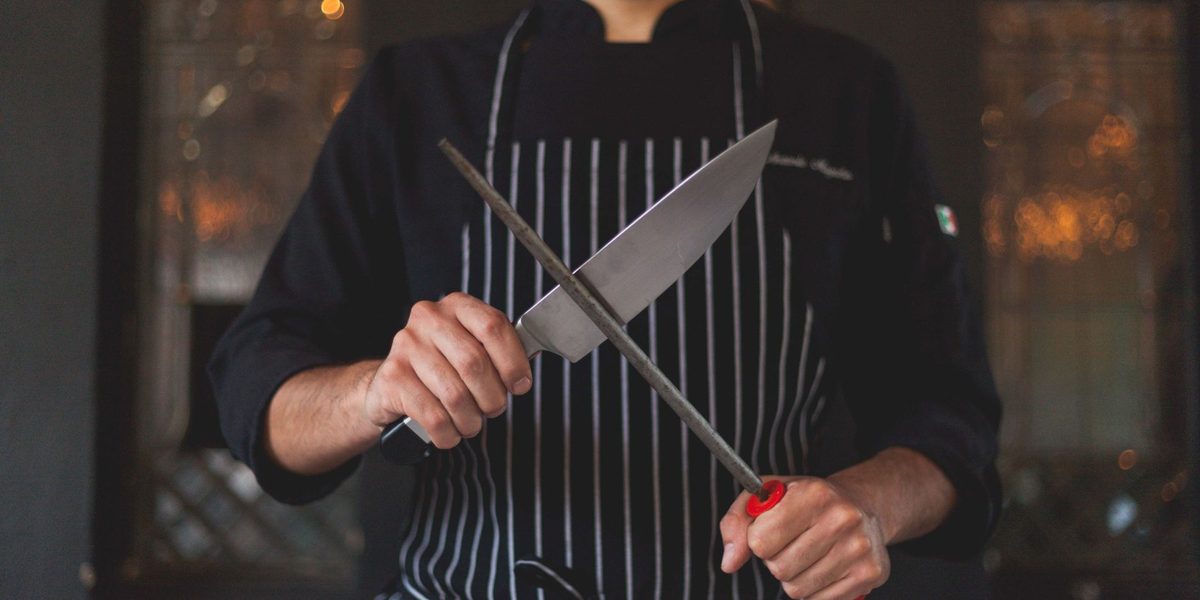
Whichever route you choose, the force multiplier is honing. A few strokes on a honing rod each week realigns the rolled edge and stretches the interval between true sharpenings dramatically. The unsustainable fourth option — doing nothing — is the one most kitchens run, and it converts good knives into bad ones within a year of purchase.
Beware the gadget middle ground: pull-through sharpeners with aggressive carbide slots restore a crude edge quickly while gouging away steel at many times the rate a stone does. Used monthly for years, they visibly shrink and hollow a blade — the only common way a home knife actually consumes its steel prematurely. If convenience is the priority, ceramic-wheel manual sharpeners and guided systems deliver it at a far gentler cost to the blade.
What Twenty Years Actually Costs
Run the ledger on a quality chef's knife owned for two decades and the numbers embarrass nearly every other kitchen purchase. The knife itself, amortized over twenty years, costs less annually than a takeout meal. Add a stone or sharpener, a honing rod, and a decent cutting board and the total ownership cost stays trivial — while the alternative path, replacing a mediocre knife block every few years as its contents dull beyond use, quietly costs more and cooks worse the whole time.
- The knife: a one-time cost spread across decades.
- Sharpening: either a one-time tool purchase or a small annual service fee.
- Boards: the recurring accessory — wood or plastic, replaced or resurfaced as they wear, and the true consumable of the cutting station.
- Storage: a strip, block, or edge guards, bought once to stop the drawer from eating your edges.
Cost per use lands at effectively zero. Few products in the home get there; almost none get there while improving your daily experience the way a sharp knife does.
The Habits That Decide Everything
Knife longevity is behavioral, and the rules are short. Never the dishwasher — heat, detergent, and rattling contact destroy handles and edges alike; wash and dry by hand, immediately for carbon steel. Cut on wood or plastic, never glass, stone, or ceramic plates, which blunt an edge in a single meal's prep. Store knives so edges touch nothing: a magnetic strip, a block, or in-drawer guards. Use the right knife for the job — no twisting through frozen food, no prying, no bones for the slicer. And hone weekly, because the difference between a knife that needs sharpening twice a year and one that needs it monthly is thirty seconds of habit.
Repair, Restore, or Retire
Knives sit unusually far toward the repair end of the repair-or-replace spectrum. Chips, broken tips, scratched blades, and wobbly edges are all grinding jobs a professional sharpener handles inexpensively. Rust and patina on carbon steel clean off with mild abrasives. Handles can be re-riveted or replaced on knives with full tangs — a favorite job of hobbyists — though on budget knives the labor exceeds the knife's value. Retirement is reserved for structural failure: cracked tangs, blades ground past useful geometry, or handles on cheap knives that no longer hold. Even then, an old knife often demotes gracefully into a garden, workshop, or camping role rather than the bin.
Final Thoughts
Across twenty years, a kitchen knife asks less of you than nearly anything else you own — hand washing, sane storage, a weekly hone, and an occasional date with a stone — and repays it with daily performance that never has to decline. The knives that fail were mostly murdered: dishwashered, glass-boarded, drawer-tumbled, and never once sharpened. Buy one good blade instead of a block of mediocre ones, learn any sharpening method you will actually practice, and the knife you cook with this year can be the knife you cook with in retirement — sharper, if anything, than the day it arrived.