The pursuit of crispy food at home has produced three competing technologies and one very effective marketing campaign. Deep frying is the ancient champion nobody wants to clean up after; the convection oven is the incumbent hiding in most kitchens; and the air fryer is the countertop phenomenon that claims to deliver the first one's results with the third one's effort. Sorting the truth out matters, because these machines overlap enough that most households need fewer of them than they own. Here is the honest verdict on what each method actually does, where the air fryer's hype is earned, and which setup deserves your counter.
First, an Honest Definition
The air fryer's name is marketing; its engineering is a small convection oven. A fan drives hot air rapidly around food in a compact chamber, evaporating surface moisture fast enough that the outside dehydrates and browns while the inside cooks. That is not frying — frying transfers heat through hot oil, cooking the surface in a way circulating air cannot fully imitate. Understanding this explains everything that follows: the air fryer competes with your oven far more directly than it competes with a pot of oil, and its real advantages are concentration and speed, not a new kind of physics.
Why does the countertop box often out-crisp the big oven if they work the same way? Size and proximity. The small chamber preheats in a couple of minutes, holds intense heat close to the food, and its perforated basket lets air attack every side at once. The full-size convection oven does the same job more gently across more space — and, crucially, does it for an entire tray at a time.
What Deep Frying Does That Nothing Else Can
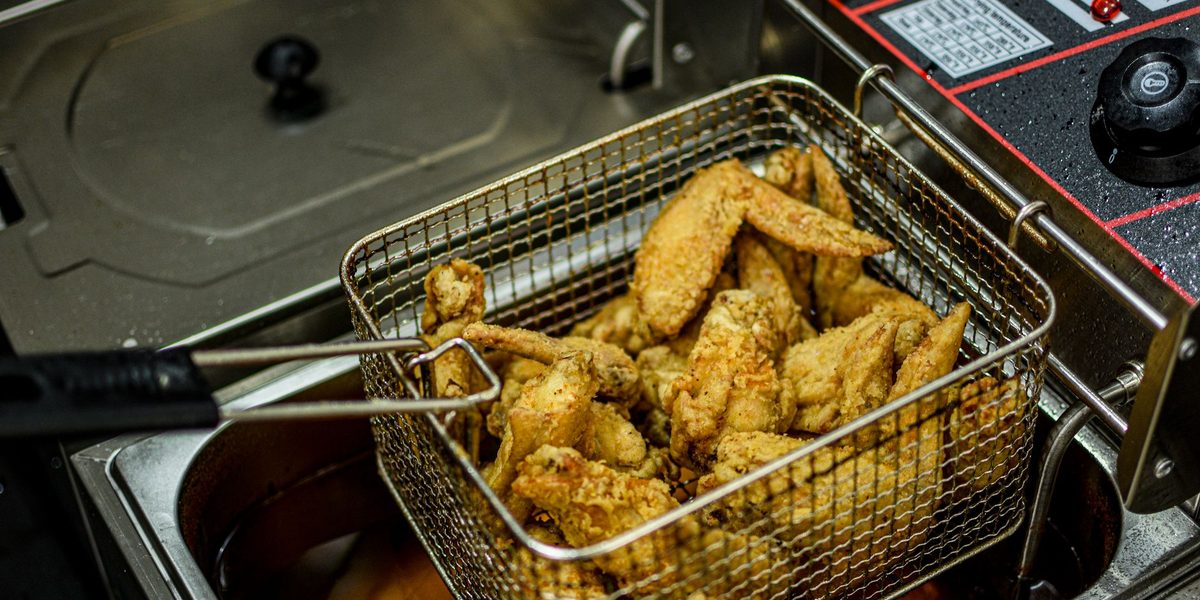
Honesty requires starting with the champion. Deep frying produces textures the other methods only gesture at: the shattering crust of proper fried chicken, the glassy exterior of a real french fry, battered fish whose coating puffs and crisps in seconds, doughnuts, tempura, anything wet-battered — which simply cannot be made in moving air, since batter drips and slumps without oil to set it instantly. Oil's heat transfer is fast, uniform, and total, and for the dishes built around it, there is no substitute.
The costs are equally undeniable: quantities of oil to buy, manage, strain, store, and eventually dispose of; lingering smell; splatter; a burn hazard; and a cleanup that discourages weeknight use. Deep frying at home is not obsolete — it is reserved. It belongs to households that truly love fried food, make it as an occasion, and accept the logistics as part of the craft. Everyone else was never going to fry often enough to justify the pot, and no comparison should shame them into it — the fried food they crave a few times a year is honestly better bought from a kitchen that fries every day.
Where the Air Fryer's Hype Is Earned
Within its real category — fast, intense convection — the air fryer is genuinely excellent at a specific list. Frozen prepared foods are its kingdom: fries, nuggets, spring rolls, and their freezer-aisle relatives emerge crisper than oven versions in half the time, with no preheating ceremony. Reheating is its second crown — leftover pizza, fried chicken, and anything that a microwave turns to sorrow comes back with its texture restored, a talent so useful that some owners report it quietly became the machine's main job within a month of purchase. Add crispy chickpeas and vegetables, bacon without a spattered stove, decent wings, and small batches of roasted anything, and you have an appliance that earns daily use in the right household.
Its honest limits: capacity, above all — the basket feeds one or two people well, and cooking for four means batches, which erases the speed advantage; wet batters are impossible; breaded coatings need oil spray or they emerge pale and dusty; and results, while very good, sit a clear step below actual frying for the marquee dishes. The air fryer is not a deep fryer without guilt. It is a small, fast oven with superb ventilation — which happens to be a very useful thing.
The Case for the Oven You Already Own
The convection oven's virtues are unglamorous and substantial. It feeds a family: whole trays of fries, two sheet pans of vegetables, a full batch of wings for game night. It does everything the air fryer does — the same physics, gentler and larger — merely slower to preheat and slightly less aggressive at crisping small items. High heat, a proper sheet pan, food spaced out rather than crowded, and a light coat of oil close most of the texture gap the countertop box brags about.
For one-or-two-person households, the oven's size works against it: heating a large cavity to crisp a single portion of fries is slow and wasteful, which is precisely the niche the air fryer colonized. For bigger households, the calculus flips — batch-cooking in a basket is a chore, and the oven quietly wins back most of the workload. The most honest single sentence in this comparison: the air fryer's true rival is not the fryer or the oven, but the size of your household. Count the plates at your average dinner before counting watts or presets, and the right machine usually announces itself.
The Verdict by Kitchen
- Singles and couples: the air fryer earns its counter space easily — fast portions, easy cleanup, superior reheating. The oven handles the occasional crowd.
- Families of four and up: the convection oven is the workhorse; an air fryer is a pleasant sidekick for snacks and reheating, not a replacement. A large toaster-oven-style air fryer splits the difference.
- Fried-food devotees: keep frying — a heavy pot and a thermometer beat any workaround for the dishes that matter — and use the oven or air fryer for the other six days.
- Tiny kitchens: one appliance only, and it should be the oven-style air fryer that toasts, bakes, and crisps, replacing two gadgets at once.
- Health-motivated buyers: the honest framing is that air-fried food is oven-roasted food — far less oil than deep frying, similar to a well-run sheet pan. The benefit is real versus takeout habits, modest versus your own oven.
Getting the Best From Whichever You Choose
Technique moves results more than the machine's badge. Do not crowd — in a basket or on a sheet pan, food touching food steams instead of crisping, and a second batch beats a soggy single one. Use a little oil deliberately; a light spray or toss is what turns breaded and starchy surfaces golden in moving air. Dry food before cooking, since surface moisture is the enemy of every method except the oil pot. Shake or flip once, midway. And preheat honestly — even the air fryer's brief warm-up matters for anything where crust is the point.
Final Thoughts
The honest verdict: deep frying remains the uncontested master of true fried texture and has every right to stay an occasion rather than a routine; the air fryer is a superb small convection oven whose speed, cleanup, and reheating powers justify the hype for small households and snack-heavy ones; and the full-size convection oven remains the most underrated crisping machine in the house, needing only high heat and elbow room to embarrass its countertop rival at family scale. Buy for the way your household actually eats — portions, frequency, and tolerance for cleanup — and you will end up with fewer machines, hotter trays, and crispier results than any advertisement promised.