 (Image source: Gemini)
 You've probably been waiting for this moment since the credits rolled on The Way of Water back in 2022. It is now 2025, and James Cameron has finally invited us back to Pandora with Avatar: Fire and Ash. Let's be honest with each other for a second. You don't go to an Avatar movie for a complex, Shakespearean plot that keeps you guessing until the final frame. You go because you want to see things that shouldn't be possible on a movie screen. You go for the "how did they even do that" factor.
This review isn't going to obsess over whether the dialogue is a bit cheesy or if the story beats feel familiar. Instead, we are looking at the visual innovation. Is Pandora still the king of the box office for pure, unadulterated eye candy? After sitting through a three-hour theatrical experience, the answer is a resounding yes. If you were planning to wait for this to hit Disney+ on your iPad, stop right there. This is a film built for the biggest, brightest screen you can find.
The stakes are higher this time because the novelty of the ocean has faded. We've seen the whales. We've seen the glowing reefs. To keep you in your seat, Cameron had to find a new way to make the impossible look mundane. By shifting the focus from the soothing blues of the reef to the harsh, volcanic greys of the Ash People, the team at Wētā FX has managed to pull off a visual pivot that feels fresh without losing that Avatar DNA.
The Unmatched Immersion Visuals That Redefine 3D Cinema
When you first see the volcanic wastelands of the Mangkwan Clan, you'll notice something different about the light. In the previous films, everything glowed or shimmered. Here, the environment is oppressive. The "Ash People" live in a biome defined by what the tech teams call a Soot Shader. It’s a specific way of rendering skin that absorbs light rather than reflecting it. Think of it like the digital equivalent of matte black paint on a stealth bomber. It makes the characters look grounded and heavy in a way we haven't seen before.
Then there’s the magma. We’ve all seen CGI lava in a dozen different superhero movies, and it usually looks like glowing orange pasta sauce. In Avatar 3, the simulation is on another level. They used something called Phase Change Simulation to let magma cool and crack into solid rock in real time within a single shot.¹ This means you aren't seeing a "fire effect" layered over a "rock effect." You’re seeing a digital material actually change its physical properties.
The most mind-blowing moment involves the Leidenfrost Effect. This happens when magma hits the ocean and creates a silver envelope of steam around the red hot stone. Seeing this happen underwater in 3D is the kind of thing that makes you want to reach out and touch the screen. To pull this off, the render hours were astronomical. We are talking about 142,000 years of rendering time if you tried to do it on a single computer.² That is the kind of scale that defines this franchise.
Sound Design and Haptics
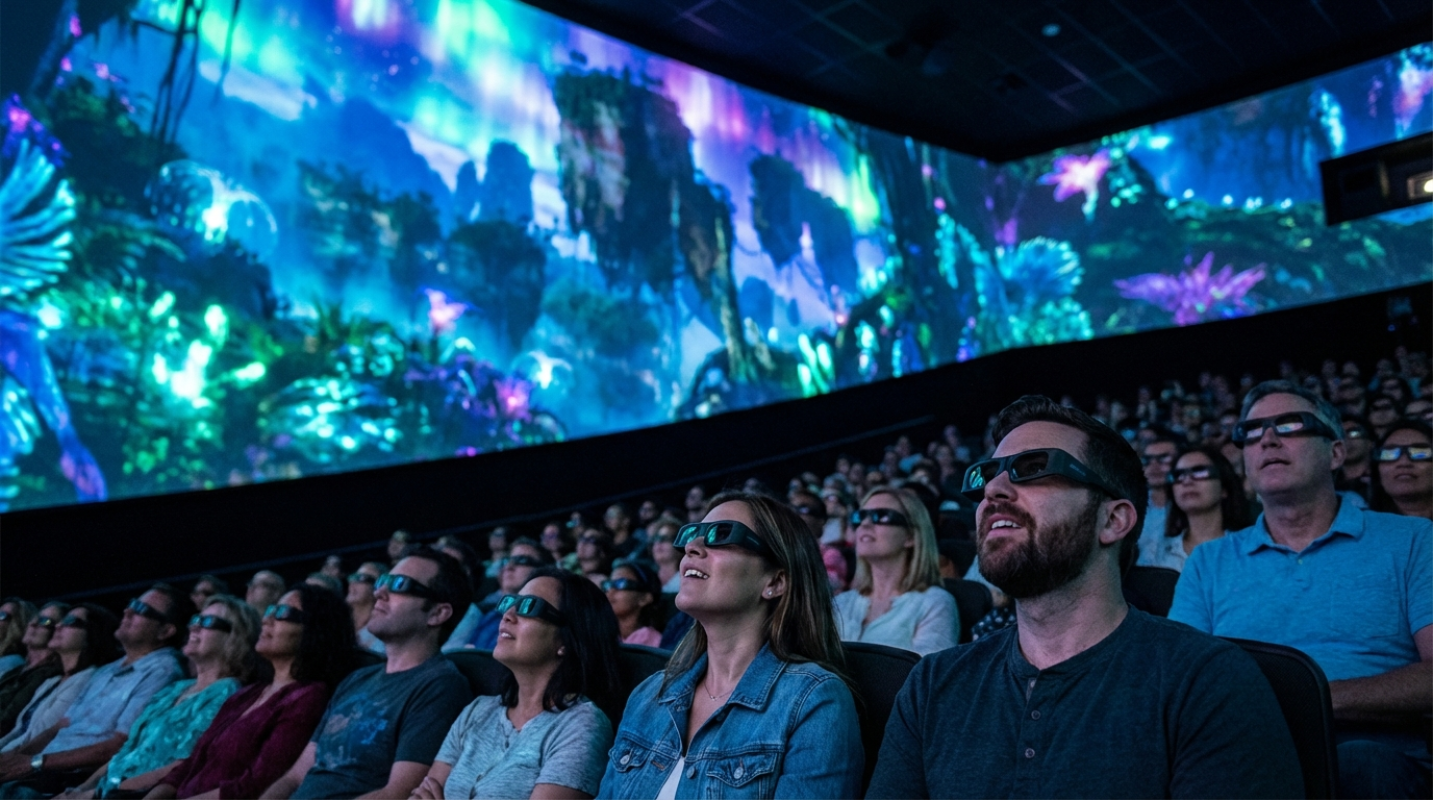
You can't have a visual feast without a soundscape that matches the intensity. If you have the chance to see this in a Dolby Cinema or a high end IMAX theater, the sound design is half the battle. The environmental storytelling through audio is incredible. When a volcanic vent erupts in the background, you don't just hear a loud noise. You hear the specific, gravelly crunch of rocks colliding and the hiss of superheated gas.
There's a specific scene where a new creature, a giant flying jellyfish called a Medusoid, drifts past the camera. The sound isn't a roar. It’s a low-frequency thrum that you feel in your chest. It’s the kind of sound mixing that makes the world feel three-dimensional even if you closed your eyes. The way the sound bounces off the canyon walls in the Wind Traders' territory creates a sense of scale that makes the theater feel a mile wide.
If you're lucky enough to be in a theater with haptic seats, the experience is even more intense. The rumbling of the volcanic ground isn't just a gimmick. It’s synced so perfectly with the low-end frequencies of the score that it feels like the theater itself is part of Pandora. It’s a reminder that Cameron isn't just making a movie. He’s building a theme park ride that lasts three hours.
Character Models and Emotional Weight - Do the Humans and Na'vi Look Better?
Have you ever felt that slight "uncanny valley" creepiness when looking at a digital character? That feeling that the eyes are just a little bit too dead? That is almost entirely gone here. The new system, which Wētā calls Emotional Capture, focuses on the microexpressions that happen around the eyes and mouth. They’ve reached a point where 90% to 95% of the actor’s actual face is mapped directly onto the Na'vi model without any animator having to "fix" it by hand.¹
This matters because the Ash People are meant to be more antagonistic and emotionally complex. You need to see the flicker of doubt or rage in their eyes to believe the stakes. The skin texture has also seen a massive upgrade. You can see the way muscles fire and slide under the skin thanks to a neural network system called Bodyopt. It’s the digital equivalent of having a real anatomy under the blue skin.
Even the human characters, who often felt a bit flat compared to the active Na'vi in the past, look more integrated into the world. The interaction between the live action actors and the digital environments is seamless. When a human character kicks up volcanic dust, the way those particles interact with their boots and clothes is perfect. There’s no "floaty" feeling where the actor looks like they are standing in front of a green screen.
The Verdict
So, should you drop the extra cash for the premium formats? If you're going to see Avatar 3 at all, you should see it in the best possible way. Standard 2D just won't do justice to the level of detail the team has poured into every frame. This is a film designed for Dual-Laser IMAX or Dolby Cinema. The contrast between the glowing magma and the dark, ashy shadows requires the kind of peak brightness that your home TV or a standard theater projector just can't hit.
The use of High Frame Rate (HFR) is also much better this time around. Cameron used TrueCut Motion technology to dial in the motion blur scene by scene.⁵ This means you get the clarity of 48fps during the high speed dragon fights without the "soap opera" look during the quiet, emotional moments. It feels natural, which is the highest praise you can give to a technical achievement like this.
Is the movie a masterpiece of storytelling? Probably not. Is it a visual triumph that makes every other blockbuster look like a low budget TV show? Absolutely. Even if you find the plot a bit predictable, the sheer create on display is worth the price of admission. It’s a reminder that the theater is still the only place where you can truly get lost in another world.
Sources:
1. Inside Weta’s VFX Pipeline for Avatar: Fire and Ash
2. 142,000 Years of Rendering: Inside the VFX that Power Avatar: Fire and Ash
3. Avatar: Fire and Ash TrueCut Motion and HFR Analysis
Content on OverReviews is for informational and educational purposes only. Readers are encouraged to consult qualified professionals and verify details with official sources before making decisions. This content does not constitute professional advice.