 (Image source: Gemini)
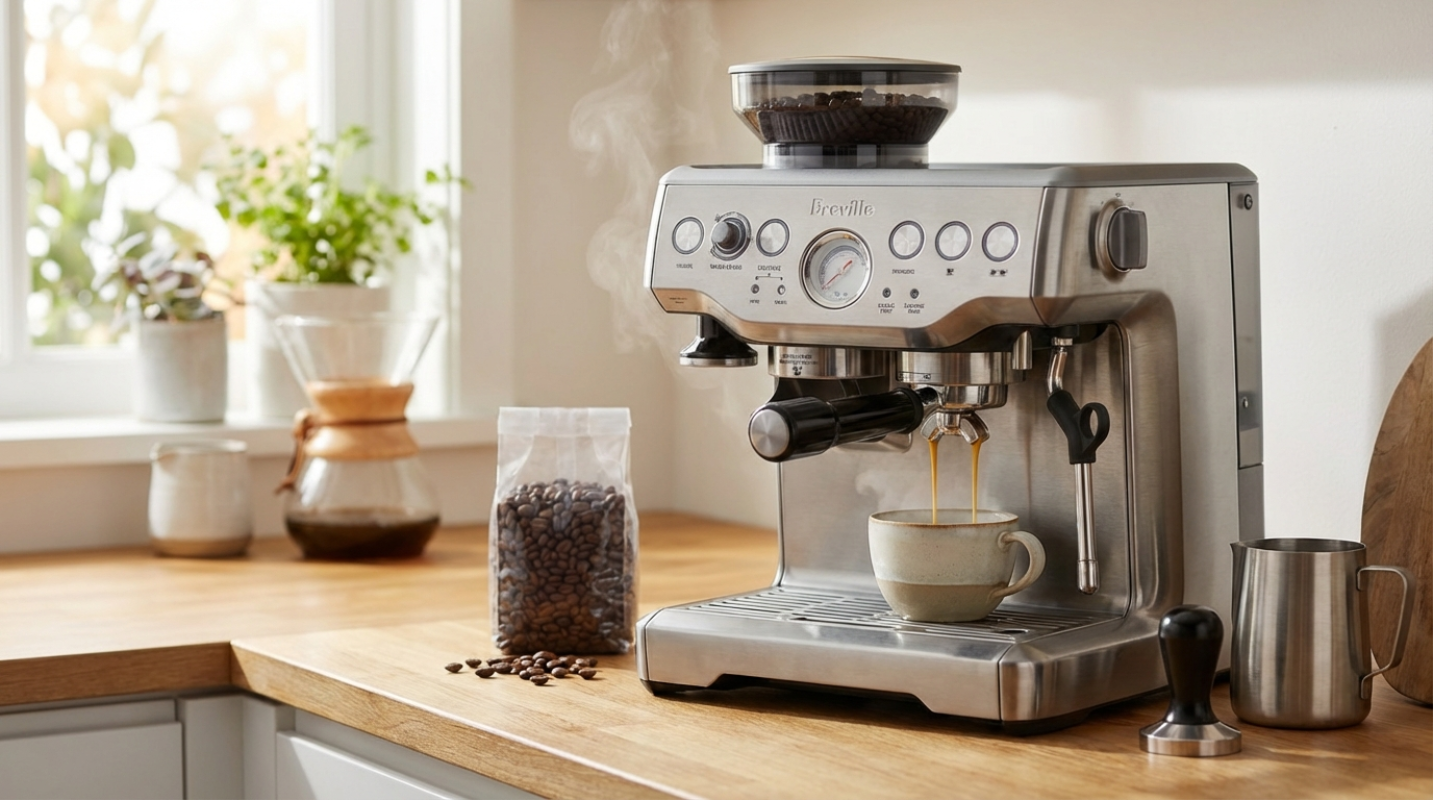
 Imagine you are standing in your kitchen at 7:00 AM. You want a latte that actually tastes like coffee, not the watered-down disappointment from a pod machine. You have likely seen the Breville Barista Express (BES870XL) in every "best of" list for the last decade. It is the shiny, stainless steel centerpiece that promises to turn your counter into a high-end cafe. But why does it still dominate the market in 2026?
The reason is that it puts everything you need, a conical burr grinder, a high-pressure extraction system, and a manual steam wand, into one single footprint. It is the entry point for someone who wants to take coffee seriously without buying three different pieces of equipment. You get the control of a semi-automatic machine with the convenience of an integrated workflow.
So what does this actually mean for your morning routine? It means you are responsible for the results. This is not a "press a button and walk away" kind of relationship. It is a hobby in a box. In this review, we are going to look at whether this legacy machine still holds its own against the newer, flashier models that have flooded the market recently. Does it still deliver professional results for the price, or are you better off looking elsewhere?
Design, Build Quality, and Initial Setup
When you first pull the Barista Express out of the box, the weight tells you a lot. It is a 23-pound beast of brushed stainless steel. It feels substantial. Unlike many modern competitors that rely heavily on plastic shells, this machine feels like it belongs in a professional kitchen. It has a footprint that fits comfortably under standard cabinets, though you will want to make sure you have room to reach the water tank in the back.
The unboxing experience is famously thorough. Breville includes everything: a heavy-duty portafilter, four filter baskets, a stainless steel milk jug, and even a cleaning kit. You won't need to run to the store for accessories on day one. Setting it up for the first time involves a bit of "priming." You'll run a few water cycles through the group head and the steam wand to get the internal thermocoil ready for action.
How does it compare to something like the De'Longhi La Specialista? Although the De'Longhi offers more automated tamping features, the Breville feels more "authentic" to many users. The buttons have a satisfying click, and the analog pressure gauge in the center gives it a classic, laboratory vibe. It is a machine that invites you to touch it and tweak it. It is a reliable workhorse that many users find lasts between 3 to 5 years of daily use before needing any major internal parts replaced.¹
Grinding and Extraction Consistency
The heart of this machine is the integrated conical burr grinder. It is convenient, but it is also the part of the machine that shows its age the most in 2026. You get 16 grind settings, which sounds like a lot until you start trying to "dial in" a tricky light roast. For traditional dark roasts, it is perfectly adequate. But if you are a coffee nerd who loves experimental beans, you might find the "steps" between settings are a bit too large.
Think of the grinder like the gears on a bicycle. If the hills are steep, you want as many gears as possible to find the perfect rhythm. With the Barista Express, you sometimes find that setting 4 is a bit too coarse, but setting 3 is a bit too fine. You have to compensate by changing how hard you tamp the coffee. It is a learning curve that can be frustrating for the first week. Have you ever spent twenty minutes wasting expensive beans just to get one decent shot? Most Barista Express owners have been there.
Once you find the right grind, the extraction performance is solid. The machine uses a PID temperature control system. This is just a fancy way of saying it keeps the water at a very stable temperature so you don't "scald" the coffee. It also features a low-pressure pre-infusion. It gently soaks the coffee grounds before hitting them with the full 15 bars of pressure. This helps prevent "channeling," which is when water finds a weak spot in the coffee puck and ruins the flavor.
One thing to keep in mind is that while the pump can hit 15 bars, most experts agree that 9 bars is the "sweet spot" for espresso.² The Barista Express can sometimes over-pressurize if you aren't careful with your dose. This is where that analog gauge becomes your best friend. If the needle is in the gray zone, you are doing fine. If it's buried all the way to the right, your coffee is going to taste bitter and harsh.
Milk Texturing and Workflow Efficiency
If you love lattes or flat whites, the steam wand is where you will spend half your time. It is a single-hole manual wand. It is not the fastest wand on the market. It uses an older thermocoil system, which means it takes about 30 to 45 seconds to get up to steam temperature. Compared to the newer "ThermoJet" systems in the Barista Pro that heat up in three seconds, the Express feels a bit slow.
But here is the trade-off: the slower steam actually makes it easier for beginners to learn. You have more time to position the pitcher and get the "vortex" going. Achieving that silky, wet-paint microfoam is very doable here. It just takes a little patience. The wand is on a ball joint, so you can move it around easily to find the right angle for your milk jug.
The workflow is where the all-in-one design shines. You grind directly into the portafilter, tamp it with the magnetized tamper that hides in the machine, and lock it in. It is a smooth, satisfying process. But maintenance is the tax you pay for this convenience. You have to be diligent. If you use oily beans, that grinder will clog. If you have hard water, the internal scale will kill the machine within two years.
Cleaning isn't hard, but it is mandatory. The machine will light up a "Clean Me" indicator when it is time for a backflush cycle. Do not ignore it. Also, you'll need to replace the group head gasket every year or so. If you start seeing leaks around the portafilter, that's a $10 part and a five-minute fix. If you treat this machine like a cheap toaster, it will break. If you treat it like a car, it will last you a decade.
Value
Is the Barista Express still worth the $699 MSRP in 2026? That depends on who you are. If you are the type of person who wants the "hobbyist" experience without the "hobbyist" price tag, it is still a fantastic value. You can often find it on sale for closer to $550, and at that price, it is almost unbeatable as a complete package.
The competition has changed, though. A few years ago, there weren't many great standalone grinders for under $200. Today, you can buy a Breville Bambino Plus and a high-end standalone grinder for roughly the same price as the Barista Express. That "split" setup actually gives you better coffee because standalone grinders are generally more precise than the one built into the Express.
So, who should buy this? It is for the person who wants a clean, beautiful counter. It is for the person who wants one cord, one warranty, and one manual to read. It is for the "set it and forget it" user who finds a bean they like and sticks with it for months. It is a classic for a reason. It is reliable, it is repairable, and it looks great in a kitchen.
The Barista Express is the digital equivalent of a manual transmission car. It requires you to pay attention. It requires you to learn the "feel" of the grind and the "sound" of the steam. It isn't the most advanced machine on the market anymore, but it is still one of the most rewarding. If you are willing to put in the work to master it, it will reward you with the best coffee you have ever had in your own home.
Sources:
1. Breville Barista Express Review 2025 Still Worth It
2. Breville Barista Express Review
Content on OverReviews is for informational and educational purposes only. Readers are encouraged to consult qualified professionals and verify details with official sources before making decisions. This content does not constitute professional advice.


.png)