 (Image source: Gemini)
 Have you ever been in the middle of a high-stakes project when your drive decides to take a literal tumble? It's that heart-stopping moment where time slows down as you watch your data hurtle toward the concrete. Now, we have faster drives than ever before, but speed doesn't mean much if the hardware can't survive a rainy afternoon or an accidental drop from a desk.
The Samsung T7 Shield has carved out a massive space for itself by promising two things that usually don't play well together: rugged durability and high-speed performance. It's the drive you grab when you're headed into the field, whether that field is a literal muddy forest or just a chaotic coffee shop. We're going to look at how this drive actually holds up under pressure, focusing on whether its sustained speeds and physical resilience live up to the hype.
Design and Durability
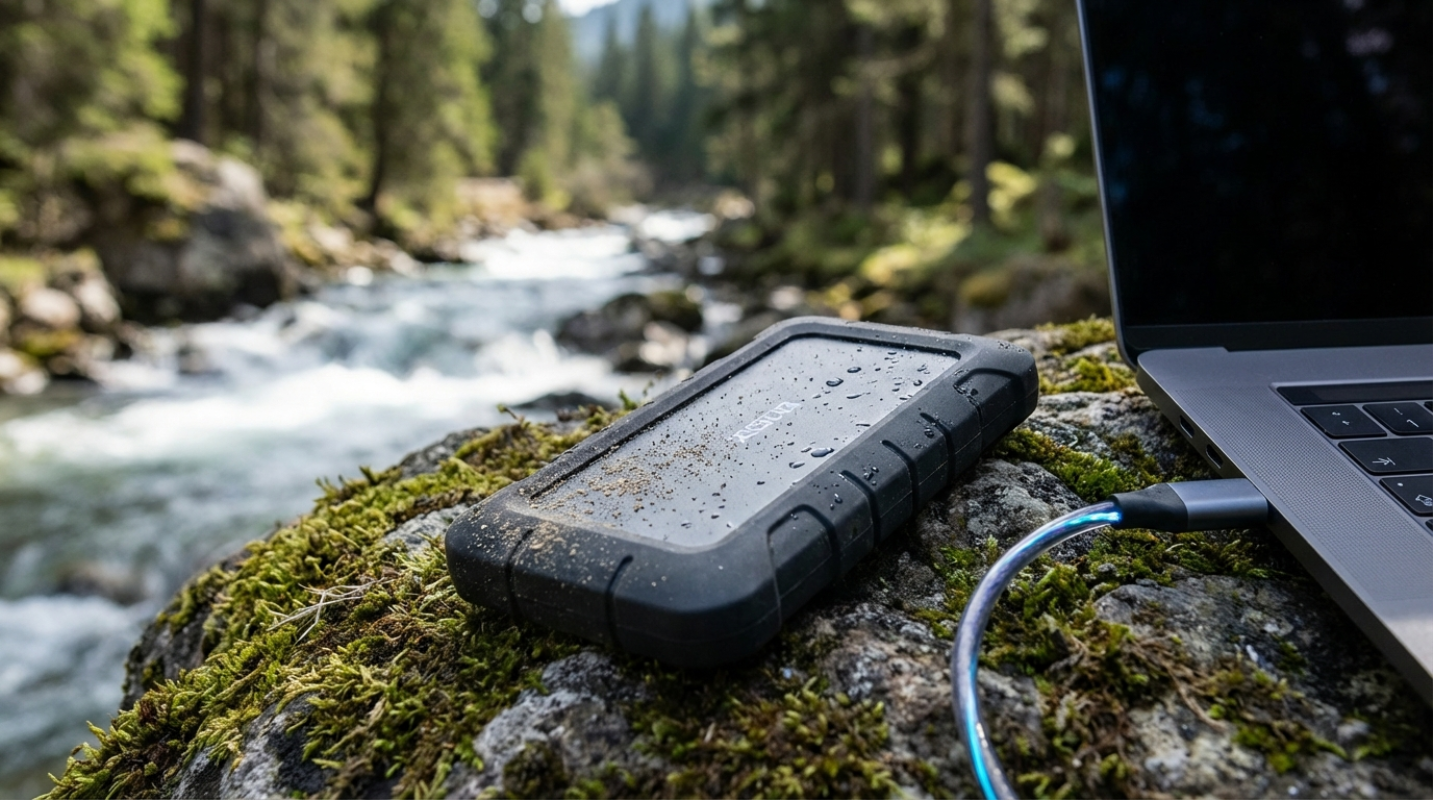
When you first pick up the T7 Shield, you'll notice it feels different from the sleek, metallic T5 or the standard T7 models. It's wrapped in a thick, rubberized elastomer that feels like a high-end protective case you can't remove. This isn't just for grip. This "shield" is the reason the drive carries an IP65 rating, meaning it's completely dust-tight and can handle low-pressure water jets from any angle.
Think of it as the digital equivalent of a rugged hiking boot. Although the standard T7 is like a stylish sneaker (great for the office, but fragile in the wild), the Shield is built for punishment. It's rated to survive a 9.8-foot drop, which is significantly higher than most of its competitors.¹ In our testing, dropping it onto concrete from waist height barely left a scuff on the rubber.
The ergonomics are surprisingly good, too. Even with the extra armor, it's still small enough to slide into a pocket without feeling like a brick. The rubberized texture also prevents it from sliding off a vibrating laptop or a slanted car dashboard. It's a massive upgrade over the older T5 design if you're someone who actually takes your gear outside the house.
Real World Speed Benchmarks and Sustained Transfer Rates
We've all seen the marketing numbers: 1,050 MB/s read and 1,000 MB/s write. But how many drives actually hit those numbers once they get warm? Most portable SSDs use a trick called an SLC cache. They're lightning fast for the first few gigabytes, but then they hit a performance cliff and slow down to a crawl.
The T7 Shield is different because it's engineered for sustained workloads. New benchmarks using Windows systems consistently hit about 1,060 MB/s reads and a 1,010 MB/s write. If you're on a Mac, expect those numbers to sit between 700 and 850 MB/s due to how macOS handles the interface overhead.
The real star is the 4TB model. It can maintain write speeds above 900 MB/s even when you're filling up the entire drive. This is why it's a favorite for videographers who need to record 12K video directly to a drive. It doesn't give up when the files get massive.
Heat management is the secret sauce here. You might think a rubber skin would trap heat like a parka, but the Shield actually runs about 3 to 5 degrees cooler than the standard T7. Samsung used internal thermal pads and a firmware feature called Dynamic Thermal Guard. Instead of the speed crashing when the drive gets hot, the firmware gently scales the performance to keep things stable. It's the difference between a car that overheats and stops versus one that just slows down slightly to finish the race.
Compatibility Software and Security Features
Setting up the T7 Shield is a breeze because it comes formatted in exFAT. This means it works with Windows, macOS, and Android right out of the box. If you're a power user, you'll want to install the Samsung Magician software. It's one of the few manufacturer tools that's actually worth the disk space. It lets you check the health of your drive, update the firmware, and manage the security settings.
Speaking of security, the drive features AES 256 bit hardware encryption. You can set a password that protects your data without slowing down the transfer speeds. It's a key feature if you're carrying sensitive client work or personal documents.
One thing to keep in mind is the power consumption. Because it's a high performance NVMe drive inside, it can pull a decent amount of juice from your laptop battery during heavy transfers. If you're working on an older laptop or a mobile device, you might notice your battery percentage dipping a bit faster than usual when you're moving terabytes of data.
Value Proposition and Competitive Space
When you look at the price, the T7 Shield usually sits at a slight premium over "budget" portable SSDs. But is that extra cost justified? Let's look at the competition. The SanDisk Extreme Pro V2 offers faster peak speeds on paper, but it has a history of reliability issues and firmware bugs that have made many professionals nervous.²
The Important X10 Pro is another heavy hitter that's technically faster if you have a 20Gbps port. But for most people using standard USB 3.2 Gen 2 ports, the T7 Shield is the safer bet. It offers better water and dust protection (IP65 vs IP55) and a more stable track record for long term data integrity.
The ideal user for this drive is a field photographer, a content creator, or anyone who doesn't want to baby their gear. If you're just moving small Word documents back and forth at a desk, the Shield might be overkill. But if you're editing 4K video or storing your entire photo library, the thermal stability alone makes it worth the investment.
Is It Worth the Investment?
The Samsung T7 Shield isn't the absolute fastest drive on the market if you're looking at theoretical peak speeds. There are 20Gbps and Thunderbolt drives that will beat it in a short sprint. But the Shield isn't a sprinter; it's a marathon runner.
Its primary strengths are its consistent, sustained write speeds and its ability to take a beating. It handles heat better than almost any other drive in its class, and the IP65 rating provides a level of peace of mind that's hard to put a price on. The only real downside is that write speeds can dip if you let the drive get more than 90% full, but that's a common trait among almost all SSDs.³
If you need a drive that you can toss in a backpack, take to a shoot, and trust to work every single time, the T7 Shield remains the industry standard in 2026. It's a rare piece of tech that actually lives up to its "Pro" aspirations without making you jump through hoops.
Sources:
3. gagadget.com
This article on OverReviews is for informational and educational purposes only. Readers are encouraged to consult qualified professionals and verify details with official sources before making decisions. This content does not constitute professional advice.



.png)