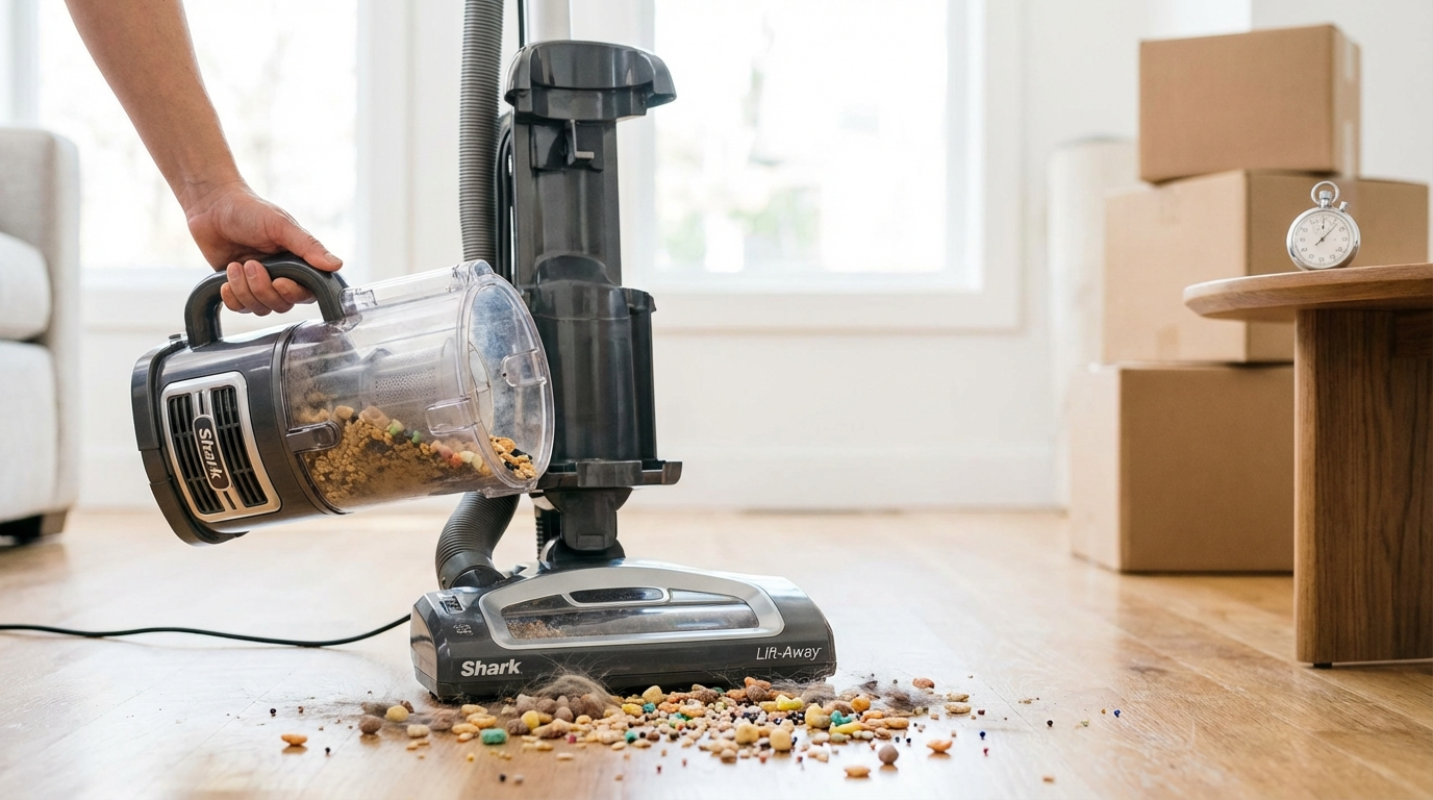
 (Image source: Gemini)
 You have probably seen the Shark Navigator Lift-Away in nearly every big-box store or online "best of" list over the last few years. It has earned a reputation as the vacuum for people who want high-end performance without the four-digit price tag of a luxury German upright. But the real question isn't just how well it cleans your living room today. It is about how well it will be cleaning that same room three or four years from now.
Does the "Never Loses Suction" promise actually hold up? Or is it just clever marketing designed to get you past the return window? In this review, we are looking at the heavy hitters of the lineup, including the classic NV352, the NV360, and the more recent LA300 series. These models define the value-tier market, but they also come with some baggage that every owner should know about before they swipe their card.
Our goal here is to get past the initial "out of the box" excitement. We want to look at the plastic fatigue, the motor strain, and the actual air wattage that moves through these machines after they have been put through the wringer. If you are tired of buying a new vacuum every two years, this breakdown is for you.
Construction Materials and Long-Term Wear Analysis
When you first pick up a Shark Navigator, it feels surprisingly solid for a machine made mostly of plastic. Shark uses a combination of ABS and polypropylene plastics to keep the weight down while maintaining a rigid frame. It is a smart choice for portability, but it comes with a shelf life. Most expert data and long-term owner logs suggest a functional lifespan of 3 to 5 years under normal household conditions.¹
Have you ever noticed those white, cloudy marks on plastic tools after they have been stressed or bent? That is called stress whitening, and you will likely see it on a Navigator after about two years of heavy use. It usually shows up around the latches and the handle connection points. Because the "Lift-Away" feature encourages you to constantly detach the canister, these connection points take a lot of abuse.
There is a bit of a divide in the community regarding how long these units actually last. Some "Vacuum Nerds" on forums report their Navigators lasting over 10 years, but there is a catch. Those users are usually the ones replacing filters every three months and cleaning the brush roll weekly. For the average person who just wants to vacuum and forget it, the 3-year mark is often where things start to rattle.
The most frustrating part of the Shark durability story is the lack of internal repairability. Unlike brands like Miele or SEBO, Shark does not typically sell individual motor components to the public. If your motor burns out after year four, you are usually looking at a full replacement rather than a simple repair. It makes the Navigator a high-performance disposable, which is something to consider if you hate adding to the landfill.
Suction Performance Metrics - Initial Power vs. Sustained Efficacy
Suction is the soul of any vacuum, and Shark leans heavily on their "Never Loses Suction" slogan. To see if that is true, we have to look at the Air Watts (AW). A standard Shark Navigator pulls about 120 AW when it is brand new. To give you some context, a top-of-the-line Dyson Ball Animal 3 pulls around 290 AW, while a budget-friendly Bissell CleanView sits around 100 AW.
So, how does it handle a full bin? This is where the testing gets interesting. The Shark cyclonic system is remarkably effective at keeping dust away from the main motor. In our tests, the Navigator maintained about 90% of its initial suction power until the dust cup was roughly 75% full.² Once you pass that 75% mark, you will notice a significant drop in airflow as debris starts to crowd the internal cone-shaped screen.
On low-pile carpets, the Navigator is a beast. It can recover about 93% of heavy debris like sand and rice in a single pass. That is impressive for a mid-range machine. It actually outperforms many vacuums that cost twice as much in the short term. But the story changes slightly on high-pile rugs where the fixed brush roll height can sometimes struggle to "breathe," leading to a feeling of the vacuum being glued to the floor.
Suction retention is also heavily dependent on your maintenance habits. If you let the fine dust build up in the foam filters, the motor has to work twice as hard to pull air. This creates a feedback loop of heat and decreased performance. If you are diligent about washing those filters, the suction stays remarkably consistent for the first few years of ownership.
Maintenance and Filtration Impact on Longevity and Performance
If you want your Shark to survive past the 3-year mark, you have to treat the filters like they are the lungs of the machine. The Navigator uses a multi-stage system: a foam filter, a felt filter, and a HEPA filter. The foam and felt ones are washable, which is great for your wallet. But here is the trap: if you don't let them dry for a full 24 to 48 hours, you are pulling damp air into a high-speed motor. That is a recipe for a dead vacuum.
The brush roll is another area where maintenance dictates durability. In homes with pets or people with long hair, the brush roll becomes a magnet for tangles. If you don't clear that hair out, it eventually migrates into the bearings. By year three, the friction can actually melt the plastic end-caps of the brush roll. Have you ever heard a Navigator making a loud, rhythmic grinding noise? That is usually the sound of a seized bearing trying to spin.
Then there is the "death trigger" that catches most owners by surprise: the lower hose split. There is a small, corrugated hose that connects the floor head to the main body. Because it flexes every time you turn the vacuum, it is prone to developing hairline cracks after about 18 to 24 months. These cracks are hard to see, but they cause a "mysterious" loss of suction that makes many people think their motor is dying. It is actually just a cheap plastic tube that needs replacing.
The Final Verdict
When you look at the space of vacuums, now, the Shark Navigator Lift-Away still occupies a unique spot. It is the "Honda Civic" of the cleaning world. It is reliable, high-performing, and relatively affordable, but it isn't meant to be an heirloom. You aren't going to pass this down to your children, and that is okay as long as you know what you are buying.
- The Pros: Excellent "suction-per-dollar" ratio, lightweight "Lift-Away" versatility, and a HEPA-sealed system that is great for allergy sufferers.
- The Cons: Limited repairability, plastic components that show wear after three years, and a brush roll that requires frequent manual cleaning.
Compared to a Dyson, you are getting about 40% of the power for 30% of the price. Compared to a budget Bissell, you are getting a much better filtration system and a more versatile design. For most households, the Navigator represents the sweet spot of the market. It provides professional-level cleaning results without the professional-level investment.
Is it a worthwhile long-term investment? If you define "long-term" as three to five years of excellent service, then yes. Just stay on top of those filters and keep an eye on that lower hose. If you do the bare minimum of maintenance, this machine will likely outwork anything else in its price bracket.
The reviews and opinions expressed on this site are for informational and entertainment purposes only. While we strive to provide accurate and up-to-date evaluations of businesses, products, and entertainment, the content should not be considered professional advice. Readers are encouraged to verify specific details before making any decisions.


.png)